

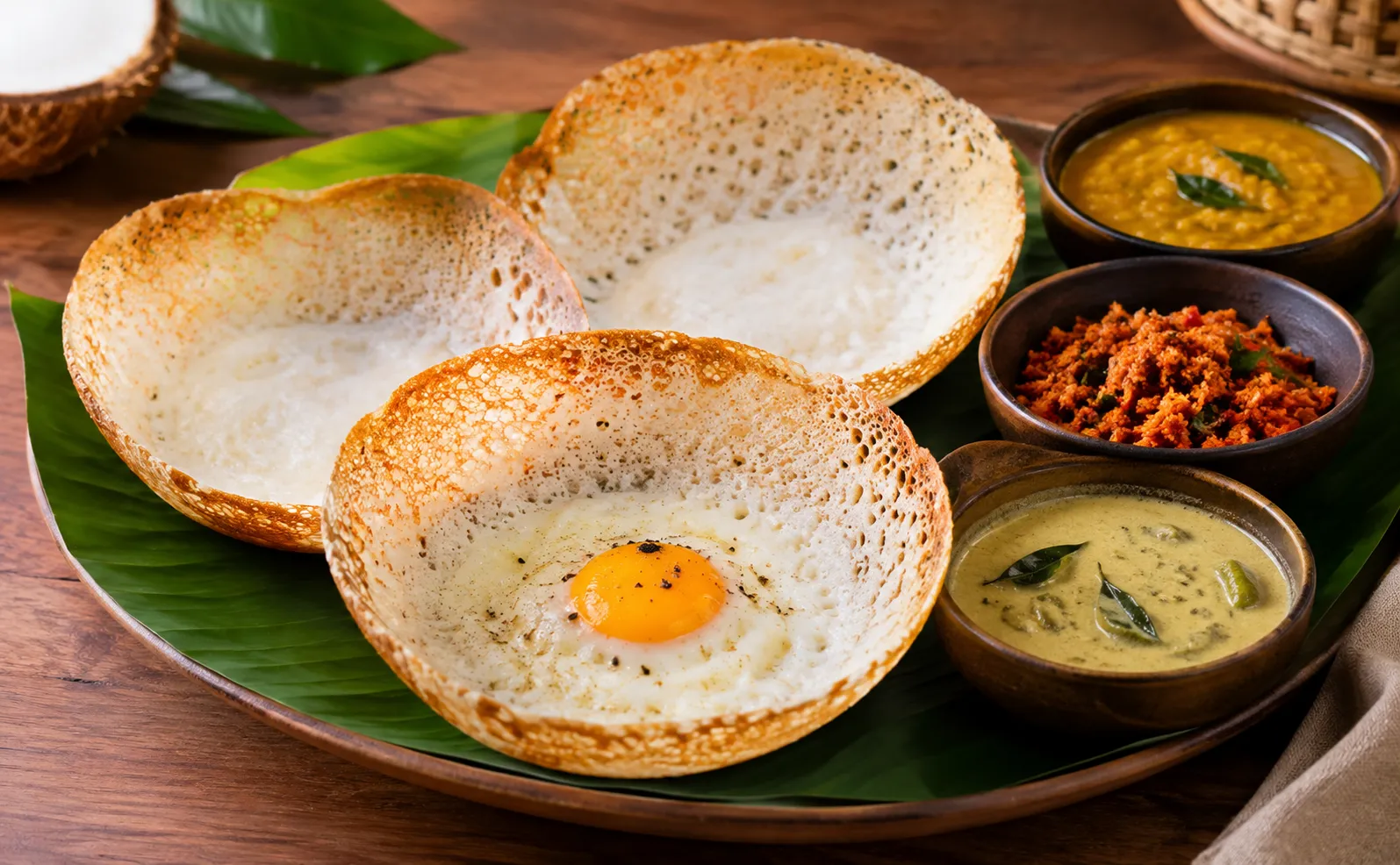
Sri Lankan hoppers are bowl-shaped pancakes made from fermented rice and coconut-based batter. They are cooked in a small curved pan, which gives them thin, crispy edges and a soft centre. Hoppers are commonly served with sambol, dhal, curries or coconut-based gravies. Popular varieties include plain hoppers, egg hoppers and milk hoppers.
If you are trying them for the first time, an egg hopper with sambol and a mild curry is a simple place to start. Hoppers are closely related to South Indian appam, but Sri Lankan versions have their own preparation methods and traditional accompaniments.
How Are Sri Lankan Hoppers Made?
Sri Lankan hoppers are made by cooking fermented rice-based batter in a small, curved pan, which gives them their familiar bowl shape, crispy edges and soft centre.
- The batter: The batter is made mainly from rice and coconut and is allowed to ferment before cooking.
- The pan: The batter is cooked in a small, curved pan called an appachatti.
- Swirling the batter: The batter is poured into the hot pan and quickly swirled around the sides. This creates a thin layer around the edges while more batter settles in the centre.
- Cooking: The hopper is cooked until the edges become thin, crispy and lightly browned, while the centre stays soft and slightly thicker.
- The final texture: This cooking method gives hoppers their distinctive crispy edge and soft centre, making them different from a flat pancake.
- Recipe variations: Traditional recipes can vary. The fermentation method, batter proportions and ingredients may differ from one recipe to another.
- Different textures: Factors such as batter consistency, fermentation time, pan temperature and cooking technique can affect the final result.
- Restaurant variations: This is why hoppers from different restaurants can look similar but have noticeably different textures and flavours.
What Gives Hoppers Their Crisp Edges?
The crisp edge develops because a thin layer of batter is spread around the hot sides of the curved pan.
The centre receives more batter, so it stays thicker and softer. This creates the characteristic two-texture experience of a hopper.
The result is a dish that is crisp around the outside but tender enough in the middle to absorb curry, sambol and other accompaniments.
What Does a Sri Lankan Hopper Taste Like?
A plain Sri Lankan hopper has a mild rice-and-coconut flavour with a subtle fermented tang.
The flavour itself is not usually very strong. Much of the overall taste comes from the ingredients served alongside it.
A plain hopper can taste slightly nutty and coconut-rich, while the crisp edge develops a lightly toasted character during cooking. An egg hopper adds richness from the egg, while a milk hopper has a softer coconut profile.
The accompaniments can completely change the experience:
- Coconut sambol adds coconut, chilli and acidity.
- Lunu miris adds a stronger chilli and onion flavour.
- Dhal curry provides a mild, creamy contrast.
- Kiri hodi adds a smooth coconut-milk flavour.
- Sri Lankan curries add deeper spice and savoury flavours.
This is why hoppers are rarely eaten as a completely plain dish. Their mild base works as a carrier for stronger flavours.
If you prefer less spice, start with a plain or egg hopper and a mild dhal. If you enjoy heat, add sambol or lunu miris gradually.
What Are the Main Types of Sri Lankan Hoppers?
The three main varieties you are likely to encounter are plain hoppers, egg hoppers and milk hoppers. They use the same basic hopper concept but differ in what is added during cooking.
| Hopper type | What it contains | What to expect |
| Plain hopper | Basic fermented batter | Crisp edge with a soft centre |
| Egg hopper | Egg cooked in the centre | Rich egg centre with crisp edges |
| Milk hopper | Coconut milk-based centre | Softer, richer coconut flavour |
Plain Hoppers
Plain hoppers are the simplest version and are a good choice if you want to experience the basic flavour and texture of the dish.
They are usually eaten with savoury accompaniments such as dhal, curry or sambol. The mild flavour of the hopper provides a base for stronger ingredients.
Egg Hoppers
Egg hoppers have an egg cracked into the centre while the hopper cooks.
The egg becomes part of the soft middle, while the outer edge develops the familiar crisp texture. Salt and pepper may be added depending on the preparation.
For a first-time diner, an egg hopper can be an easy introduction because the egg provides a familiar flavour alongside the distinctive hopper texture.
Milk Hoppers
Milk hoppers, sometimes called kiri appa, use coconut milk to create a softer and richer centre.
The exact preparation can vary between restaurants. Some versions may be served as part of a savoury meal, while others may have a sweeter profile.
If you enjoy coconut-based dishes, milk hoppers are worth asking about when they are available.
What Is the Difference Between Sri Lankan Hoppers and Dosa?
Sri Lankan hoppers and dosa are both rice-based South Asian foods, but their shape, batter, cooking method and texture are different.
The biggest visual difference is the pan. Dosa is normally spread across a flat tawa, while hopper batter is swirled inside a curved pan.
| Feature | Sri Lankan Hopper | Dosa |
| Shape | Bowl-shaped | Flat and round |
| Cooking surface | Curved pan | Flat tawa |
| Centre | Soft and thicker | Usually spread more evenly |
| Edge | Thin and crisp | Can be crisp or soft |
| Common accompaniments | Sambol and Sri Lankan curries | Sambar and chutneys |
A dosa is generally designed to be spread thinly across the cooking surface. A hopper uses the shape of the pan to create two distinct textures in one dish.
The accompaniments also reflect different regional food traditions. Dosa is strongly associated with South Indian dishes such as sambar and coconut chutney. Sri Lankan hoppers are commonly served with sambols, dhal and curries.
So, although both may look like pancakes at first glance, a hopper is not simply a Sri Lankan version of dosa.
What Is the Difference Between Hoppers and Appam?
Sri Lankan hoppers and South Indian appam are closely related dishes made from fermented rice-based batter, but regional recipes and serving styles can differ.The terminology can be confusing because appam, appa and hopper are used in different food traditions and languages.
In Kerala and other parts of South India, appam is often served with dishes such as vegetable stew, egg curry or coconut-based meat curries. In Sri Lanka, hoppers are commonly paired with sambol, dhal and Sri Lankan curries.
The cooking method is also important. Both use a curved pan, which helps create thin edges and a softer centre.
You may therefore see appam and hoppers used almost interchangeably on restaurant menus, while the actual recipe can vary depending on the regional style.
For a diner, the easiest distinction is this:
- Appam is the common South Indian name.
- Appa is commonly used in Sri Lanka.
- Hopper is the widely used English name for the Sri Lankan preparation.
- Kiri appa refers to a milk-based hopper.
What Do You Eat With Sri Lankan Hoppers?
Sri Lankan hoppers are usually eaten with sambol, dhal, curries and coconut-based gravies.
The accompaniments are an important part of the meal because the mild hopper provides a base for spicy, savoury and creamy flavours.
Coconut Sambol
Coconut sambol combines grated coconut with ingredients such as chilli, onion and lime. Some traditional recipes also include Maldive fish.
Its combination of coconut, acidity and chilli works particularly well with plain and egg hoppers.
Lunu Miris
Lunu miris is a spicy Sri Lankan relish commonly made with chilli, onion, lime and salt.
It has a stronger chilli flavour than many coconut-based accompaniments, so a small amount is enough if you are not used to spicy food.
Dhal Curry
Dhal provides a softer and milder accompaniment. Its creamy texture works well with the crisp edge and soft centre of a hopper.
You can spoon some dhal into the centre or use pieces of the hopper to scoop it up.
Kiri Hodi
Kiri hodi is a mild coconut-milk gravy associated with Sri Lankan cuisine.
Its creamy consistency pairs naturally with rice-based dishes. Recipes vary, but coconut milk and spices are common components.
For a balanced first meal, try a plain or egg hopper with dhal and a small portion of sambol.
How Do You Eat Sri Lankan Hoppers?
The easiest way to eat a hopper is to tear off a piece and use it to scoop up curry, sambol or gravy.
You can also use a spoon and fork. There is no special rule that requires you to eat hoppers with your hands.
If you are eating an egg hopper, break through the centre so that you get some egg with the soft hopper and crisp edge.
A simple method for first-timers is:
- Tear off a small piece of the hopper.
- Add a little dhal or curry.
- Add a small amount of sambol.
- Combine the textures in one bite.
- Add more sambol if you want additional heat.
The combination of textures is one of the main reasons hoppers are enjoyable. The outer edge gives you a light crunch, while the centre absorbs the flavours of the curry and sambol.
How Should a Beginner Order Hoppers?
If you have never eaten hoppers before, start with one plain hopper or one egg hopper and choose one mild accompaniment.
You do not need to order several varieties immediately. Trying one or two versions first makes it easier to understand the basic flavour.
A Simple First Order
Egg hopper + dhal + sambol
This gives you the soft egg centre, crisp hopper edge, mild dhal and spicy contrast from the sambol.
If You Prefer Milder Flavours
Choose a plain hopper with dhal or a coconut-based gravy. Add only a small amount of sambol.
If You Enjoy Coconut
Ask whether milk hoppers or other coconut-based hopper variations are available.
If You Enjoy Spicy Food
Try lunu miris or a hotter sambol alongside a plain or egg hopper.
Restaurant recipes can vary, so it is worth asking the server about the available versions. This is particularly useful if you have dietary restrictions or food allergies.
Are Sri Lankan Hoppers Spicy?
The hopper itself is generally mild, while the sambol and curry served with it provide most of the heat.
A plain hopper usually has a mild rice-and-coconut flavour with a subtle fermented note. The level of spice depends on the accompanying dishes.
Lunu miris can be particularly hot because chilli is one of its main ingredients. Coconut sambol may also contain chilli, although the coconut changes the overall flavour and intensity.
If you prefer mild food, start with dhal or a coconut-based gravy. You can then add sambol gradually.
If you avoid fish, ask about the ingredients in the sambol. Some traditional Sri Lankan sambols can contain Maldive fish.
Are Hoppers the Same as String Hoppers?
No. Hoppers and string hoppers are two different Sri Lankan dishes.
The names are similar, but their appearance and preparation are very different.
A hopper is a bowl-shaped pancake made from fermented batter and cooked in a curved pan.
A string hopper, also called idiyappam, is made by pressing rice-flour dough into thin strands. The strands are arranged into small nests and steamed.
| Feature | Hoppers | String Hoppers |
| Appearance | Bowl-shaped pancake | Small noodle-like nest |
| Main ingredient | Fermented rice-based batter | Rice-flour dough |
| Cooking method | Pan-cooked | Steamed |
| Texture | Crisp edge and soft centre | Soft and delicate |
| Common pairings | Sambol and curry | Curry, sambol and kiri hodi |
If you want the crisp-edged pancake associated with Sri Lankan restaurants, order hoppers.
If you want steamed rice noodles, order string hoppers.
When Are Sri Lankan Hoppers Usually Eaten?
Hoppers are commonly enjoyed as part of breakfast, dinner or a larger Sri Lankan meal, although restaurant serving times can vary.
They are particularly suited to freshly cooked service because the crisp edge and soft centre are most noticeable when the hopper is served hot.
In Sri Lankan food culture, hoppers can be served alongside several small accompaniments. This makes them suitable for both individual meals and shared dining.
Restaurants outside Sri Lanka may adapt their menus to local dining habits. Some may offer hoppers only during specific service periods.
If you are visiting a restaurant specifically for hoppers, checking availability beforehand can save you an unnecessary trip.
Where Can You Try Sri Lankan Hoppers in London?
If you are searching for Sri Lankan hoppers in London, Edmonton in North London is one local area to consider.
Chennai Spice is located at 213–217 Hertford Road, London N9 7ER, and serves South Indian and Sri Lankan cuisine. Its website also lists a live appam, or hoppers, station as part of its catering offering.
You may find hoppers listed under several search terms when looking for them online:
- Sri Lankan hoppers London
- Hoppers London
- Egg hopper London
- Appam London
- Sri Lankan restaurant Edmonton
- Sri Lankan food Edmonton
Availability can vary by restaurant and service period, so checking the current menu before visiting is useful.
What Should You Know Before Ordering Hoppers?
The main thing to remember is that hoppers are designed to be eaten with accompaniments.
The hopper itself has a relatively mild flavour. The sambol, curry or gravy provides much of the meal’s character.
For a first visit, keep these points in mind:
- Choose an egg hopper for a familiar and filling introduction.
- Choose a plain hopper if you want to understand the base flavour.
- Try dhal if you prefer a mild accompaniment.
- Add sambol if you enjoy chilli and stronger flavours.
- Try kiri hodi if you prefer coconut-based gravies.
- Ask about ingredients if you have allergies or dietary restrictions.
- Check availability if hoppers are the main reason for your visit.
Once you understand the basic hopper, you can experiment with different combinations.
Why Are Sri Lankan Hoppers Popular?
Sri Lankan hoppers are popular because they combine simple ingredients with contrasting textures and flavours. Their distinctive bowl shape, crispy edges and soft centre come from a simple cooking method, while the same basic hopper can be enjoyed with different curries and sambols. An egg hopper makes a more filling meal, while a plain hopper works as a base for a variety of accompaniments.
Hoppers also offer a simple introduction to Sri Lankan cuisine, bringing together familiar ingredients such as rice, coconut, egg, chilli and curry. Each bite can have a different mix of crispy edge, soft centre and curry, while the dish itself reflects an important part of Sri Lankan food culture: fermented rice-based foods served with strongly flavoured accompaniments.
Try Sri Lankan Hoppers at Chennai Spice
Sri Lankan hoppers are a good choice if you want to try something that combines rice, coconut, fermentation and contrasting textures in one dish.
For your first order, an egg hopper with dhal and a little sambol is a simple starting point. Once you know the basic flavor, you can try plain or milk hoppers with different Sri Lankan accompaniments.
If you are searching for hoppers in London, Chennai Spice in Edmonton offers South Indian and Sri Lankan food, with appam or hoppers also featured in its catering options.
Check the current menu or contact the restaurant before visiting to confirm availability.
Frequently Asked Questions
What is a Sri Lankan hopper?
A Sri Lankan hopper is a bowl-shaped pancake made from fermented rice-based batter, often with coconut, and cooked in a curved pan. It has a thin crisp edge and a soft centre.
What is an egg hopper?
An egg hopper is a hopper with an egg cooked in the centre. The egg remains in the soft middle while the outer edge becomes crisp.
Is appam the same as a hopper?
Appam and Sri Lankan hoppers are closely related. Appam is commonly used in South India, while appa and hopper are strongly associated with Sri Lankan cuisine.
What does a hopper taste like?
A plain hopper has a mild rice-and-coconut flavour with a subtle fermented taste. Sambol and curry add most of the spice and stronger flavours.
Are hoppers and string hoppers the same?
No. Hoppers are pan-cooked fermented pancakes. String hoppers are steamed rice-flour strands formed into small nests.